

Welcome to the 280 of you who have joined since our last edition, it’s great to have you here. And can you believe that we made it into the top 100 business Substacks worldwide. Honestly, you’re all incredible, thank you for being here.
A few weeks ago I gave Instinct (my personal AI agent) one job: sort out the flights and accommodation for my New Zealand trip at the end of the year. I wanted flights for less than $350 each way, and accommodation with twin beds across 7 locations for a total of under $2,000.
I’ve asked Claude and ChatGPT to do versions of this before. They research and recommend and hand me a list of links, and then the rest is on me. Claude couldn’t even give me availability or prices for the right dates. So I’d open the link. Check the prices again in three days. Forget. Check again. Finally book at $200 more than I should have.
But Instinct was the first time I’d used an agent that just did it all for me.
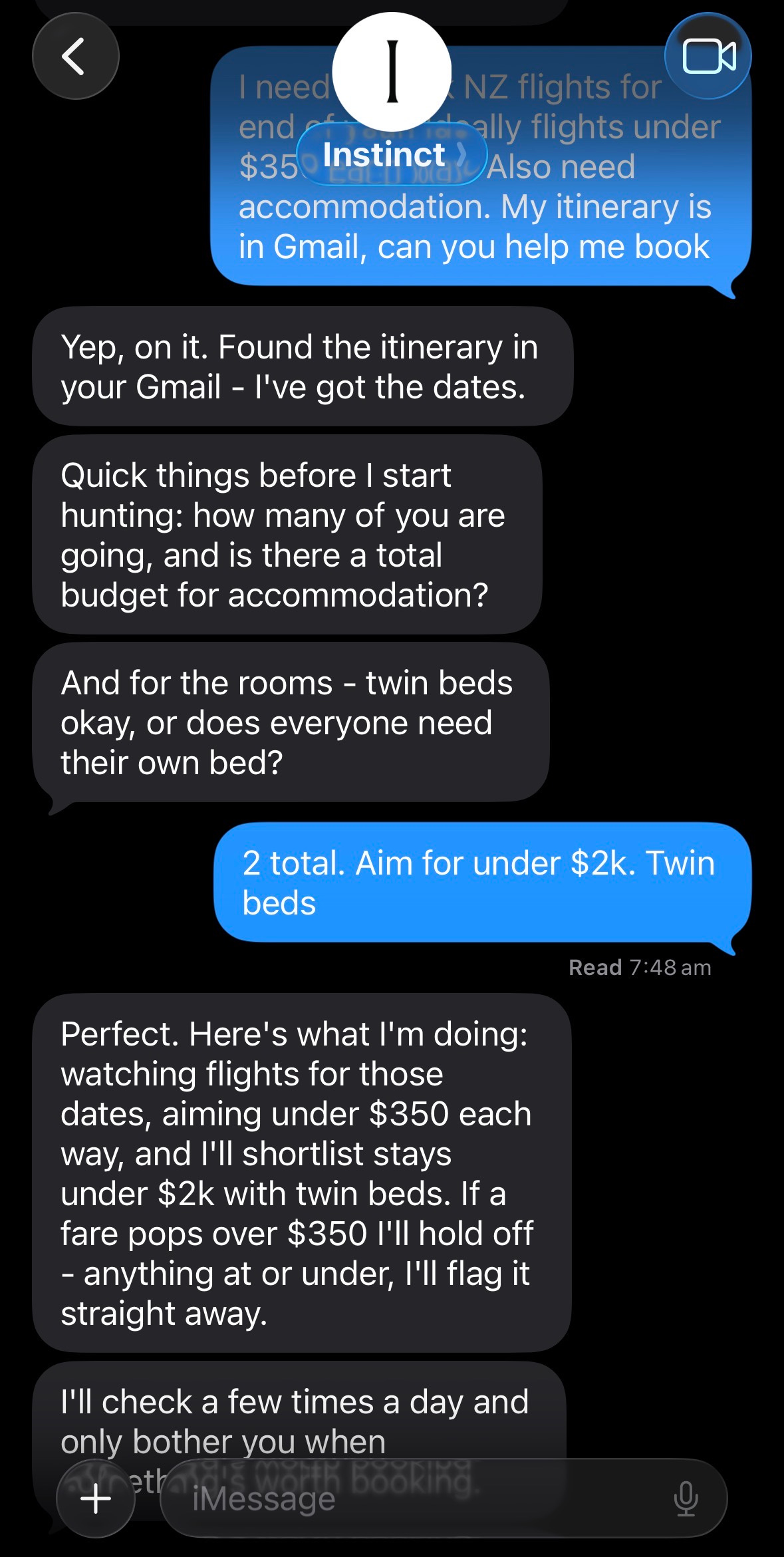
It did better than I expected. Way better. For that one kind of job, it beat the Claude setup I’ve spent months building.
That’s the first moment I truly understood why everyone is losing their minds over personal agents.
If you’re anything like me, you’ve seen the releases. You’ve seen Meta Muse launch the fuzzy white mascot. Been bombarded by Grok Bot ads. Watched the OpenClaw and Hermes hype turn into ChatGPT Dots and Claude Duet revelry. Or maybe everything I just said sounds like gibberish to you, and that’s okay too. (Remember, outside of our AI bubble, most people have never heard of them.)
Either way, you’ve been too busy, too focused on actually building something real, or just too overwhelmed with AI to figure out what the hell all of these new releases mean, and whether they can actually help you save time, make money and do less of the work you hate, or if they’re just more AI hype.
If that’s you, you’re in the right place. I’ve just spent 18 hours going down the rabbit hole, and the new era of personal agents might be the most useful thing I’ve seen AI do this year.
This is Episode 2 of Your Agent MBA, a free, anti-hype series that takes you from “I’m using AI one chat at a time” to “I run a small team of AI employees that work while I sleep.”
By the end of this edition you’ll know:
What personal agents actually are (and how they’re different to most agents)
The seven most popular personal agents
The six questions that tell you which one to use
And the three big things to ask before you start using them.
How we got here
From 2024 to 2025 we had the era of prompt engineering. You wanted a good output? Your prompt had better have a role, the goal, the context and the steps all broken down, with subheaders for each section.
Then context engineering came around, which was a big part of the Claude MBA: setting up your projects so you stop re-explaining yourself every session. Memory got better, connectors arrived, and skills were released for the very first time.
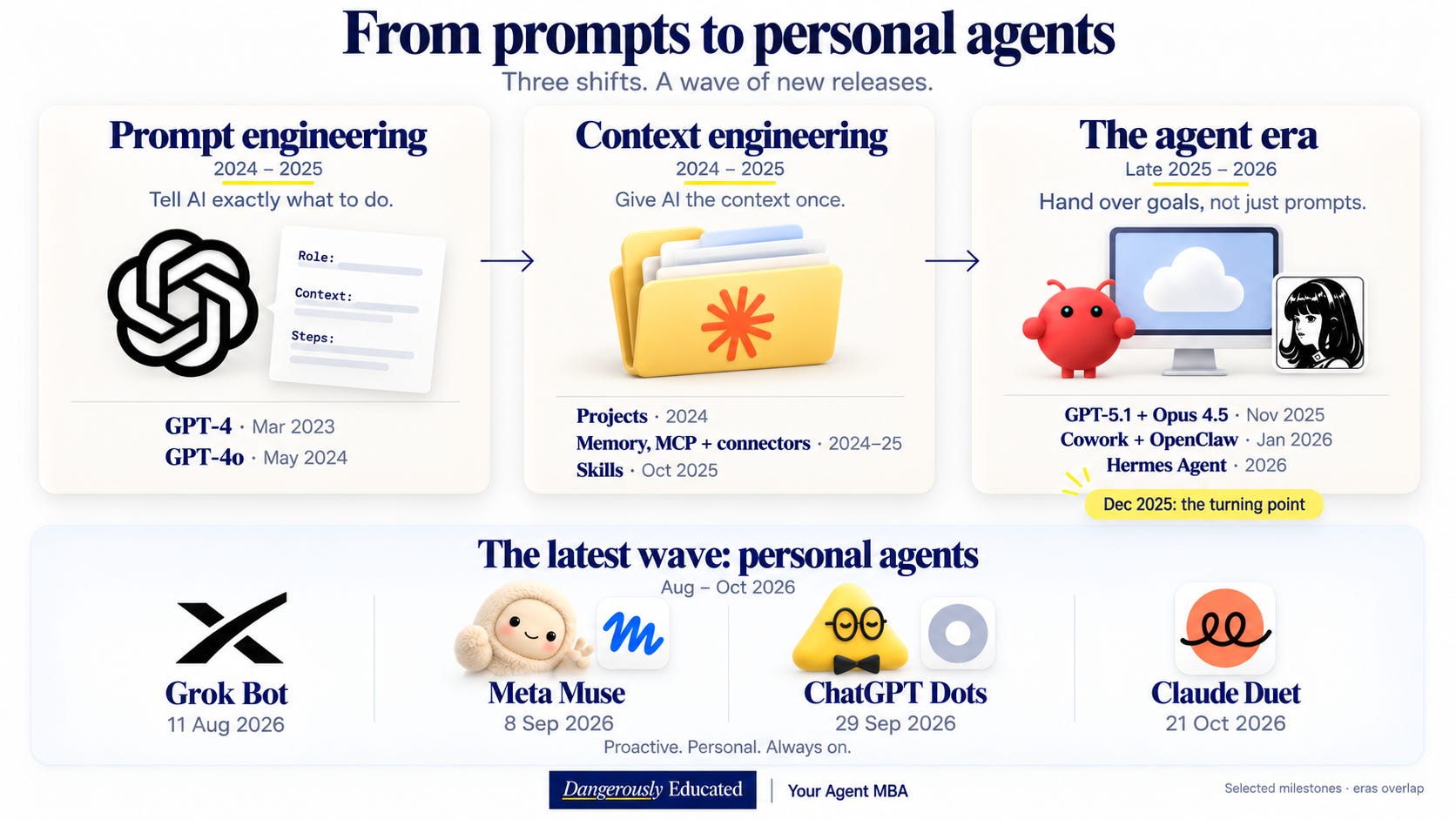
But in December 2025, the agent era began. Massive model upgrades (Opus 4.5 and GPT-5.1) plus three weeks off for Christmas created the perfect storm. Smart people had time, they used that time to experiment, and they realised just how capable AI had become.
Since then it’s been a race on two fronts:
Training the best models
Building the best agent harness (the app an agent runs in, like the ChatGPT or Claude desktop app), plus everything behind it: scheduled tasks, cloud sessions, agents handing work to each other. They’re all small upgrades, but they’re upgrades that matter.
So the models are the best they’ve ever been, the harnesses are the best they’ve ever been, and if you know what you’re doing, AI can legitimately run 70% of your work.
But what if you don’t know what you’re doing?
The reality is that most people don’t. Think about your mum or dad trying to use AI agents. Would agents be useful for them? One hundred percent. But are they about to go into Claude Code and set up the perfect folder structure, choose the model, and give it the right skills and instructions? Probably not.
On the other hand, what if you’re doing so much with AI that it drives you crazy to NOT have it working for you 24/7? To always be the one giving it instructions or setting it up on a schedule, instead of having it come to you with smart ideas? What if you’re running so many sessions and agents that you don’t want to coordinate them all manually, and just want to talk to one AI that does it for you? If you want an agent who can go beyond just doing work and handle all your life admin too?
I for one have spent far too many evenings after work connecting my laptop to hotspot and leaving my laptop open in the car while I hit the gym so Claude can keep working.
Or booking flights and appointments manually when I know I should just figure out how to get AI to do it for me.
That’s where proactive personal agents come in.
Personal agents, clearly explained
Most people think a personal agent is an upgraded chatbot. Another version of ChatGPT or Claude. It’s a lot bigger than that.
Chatbots give you a response. Agents take action for you. But both wait for you to ask before doing anything.
A personal agent uses your info to offer to help before you ask. And they’re always on.
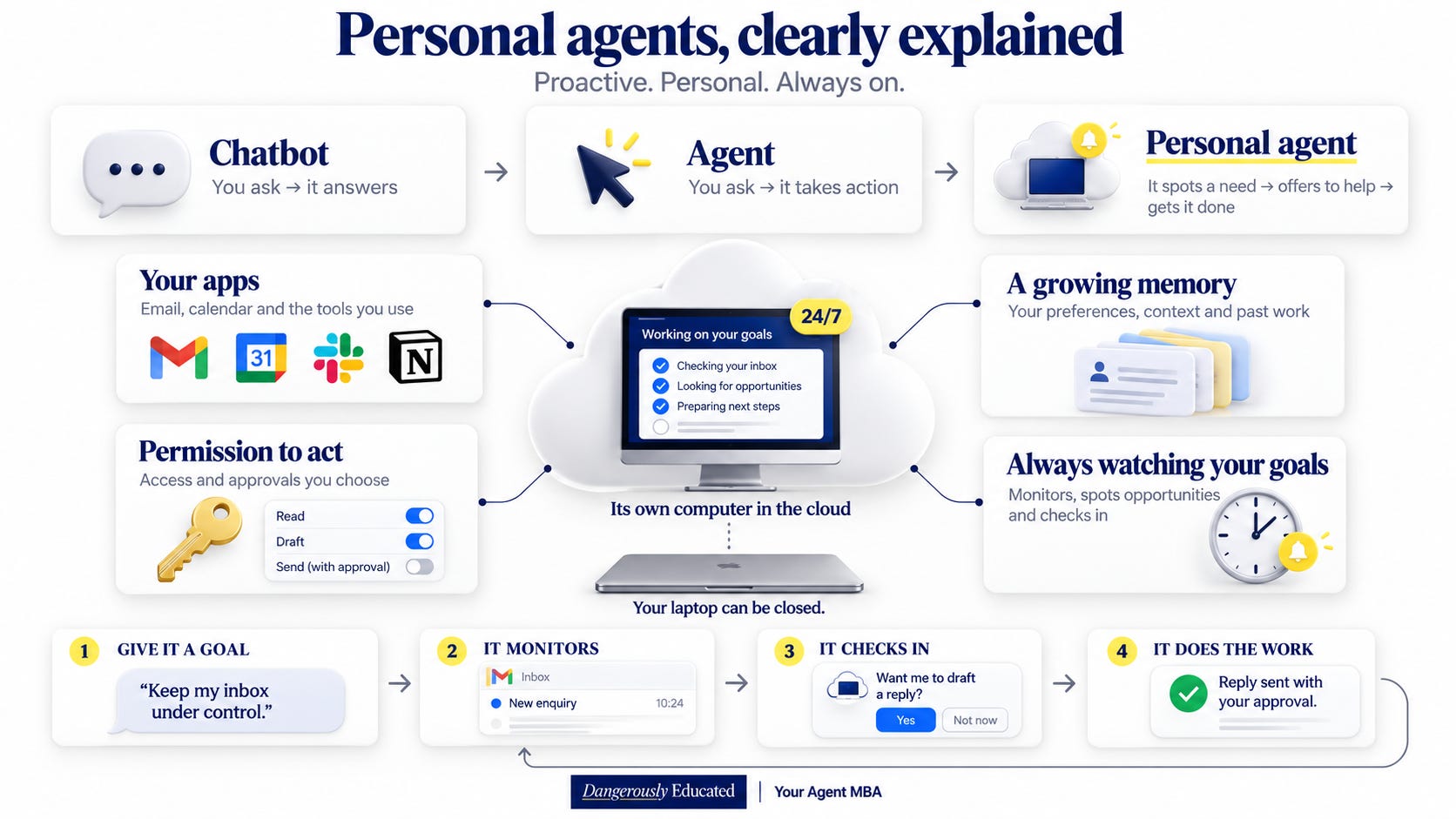
It’s an AI with its own computer in the cloud, meaning it can work 24/7 and your laptop doesn’t need to be open. It has access to your email, calendar and apps, plus permission to act, meaning it can do tasks for you. And it has a memory of you that grows every day, so it gets better at your jobs the longer you use it.
You give it a goal (”keep my inbox under control”, “find me a flight for 23 December under $300”, “reply to new enquiries within two minutes”), and it monitors, messages you when it needs to check in or spots an opportunity, then gets the work done.
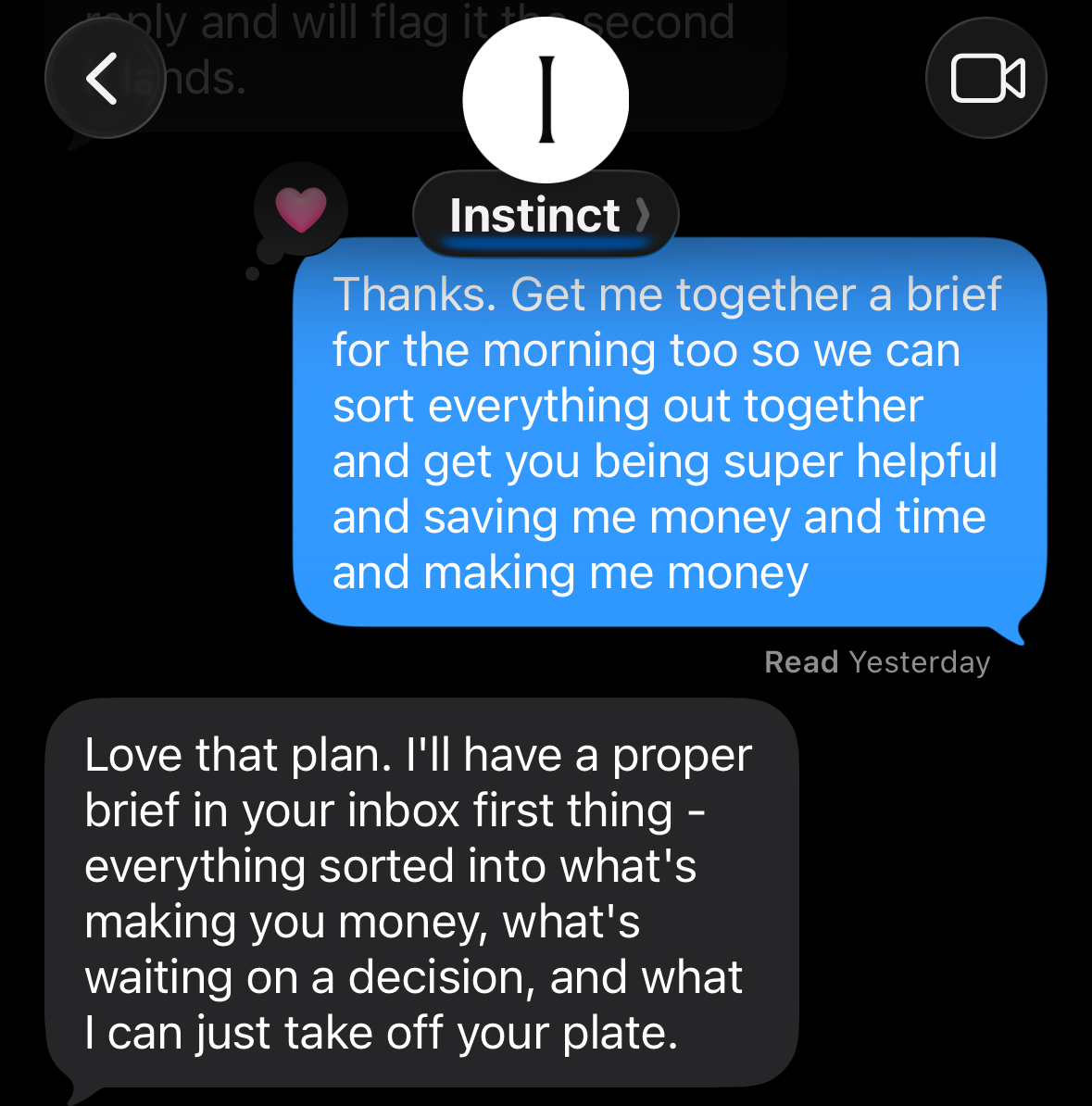
Here’s the best example I can give to explain the difference.
Three weeks ago I emailed my accountant to book an appointment to handle my tax return. He told me an appointment was free on October 30 at 5pm. I replied to confirm, but never heard anything back.
I forgot all about it until I saw my calendar appointment this week.
So I messaged Instinct (through iMessage) to send an email confirming the appointment. Here’s what I got back:
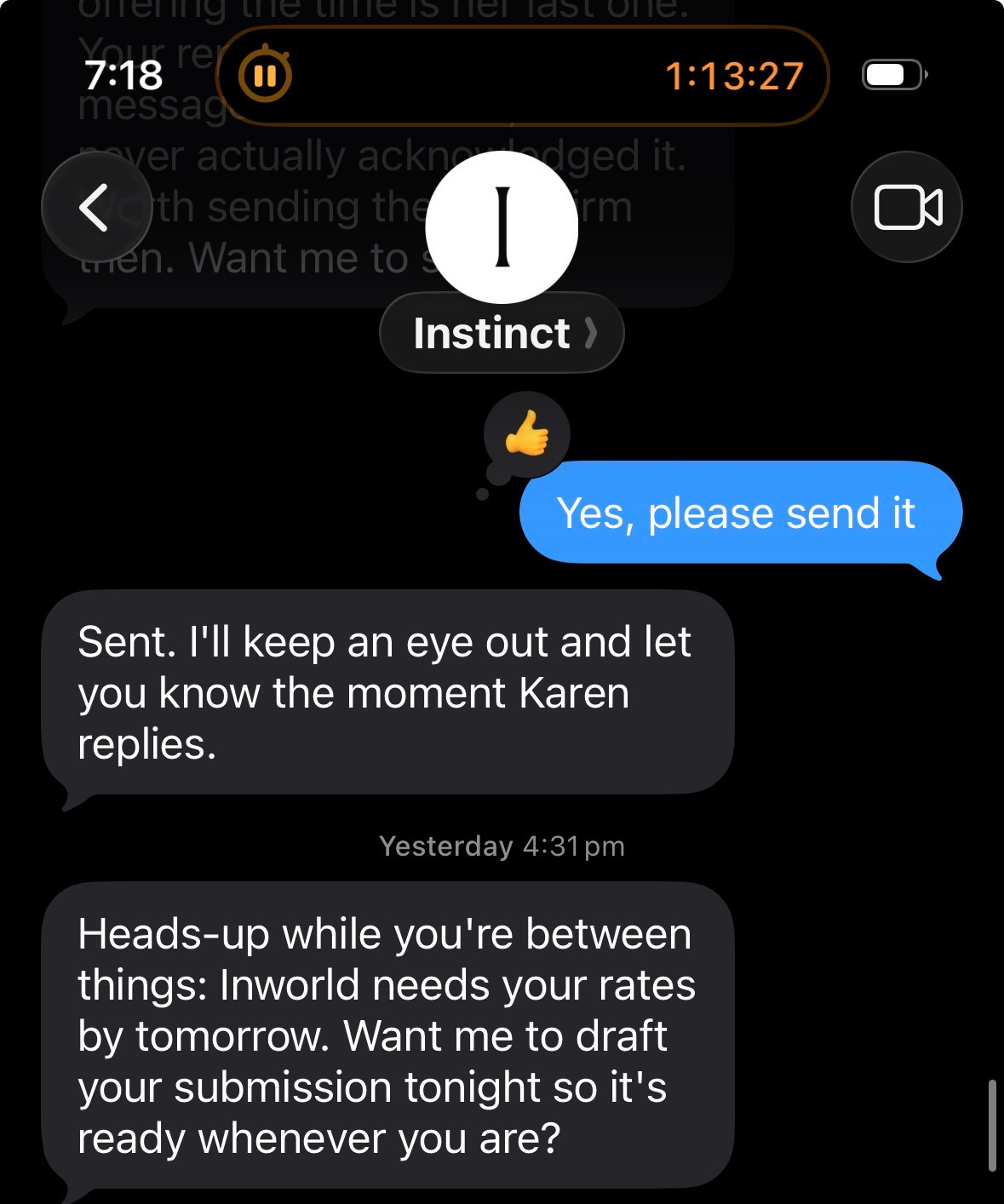
That’s the difference. The persistent monitoring. And the proactive message you can see below it. I didn’t ask Instinct to check on anything else in my Inbox. It just did it.
The most popular use cases for personal agents right now across X, Reddit and YouTube are:
Morning brief. Calendar, inbox, and what needs you today.
Inbox triage and reply drafts.
Scheduling. Finding times, sending invites, rescheduling.
Travel. Booking and rebooking, price watching.
Life admin and errands. Restaurant bookings, groceries, cancelling subscriptions.
Research while you sleep. Monitoring a topic or competitor and reporting back.
Small-business ops. Dashboards, forecasts, CRM follow-ups.
Personal finance monitoring. Popular, but also the source of the biggest horror story of the month (I’ll come back to that one).
The big theme is that AI is getting easier to use. You don’t pick the model for a personal agent (the company decides). You don’t have to write complicated briefs or skills (the agent does that itself). And you don’t have to manage Claude Code or Cowork projects (the agent spins up its own chats, has its own app or works directly in your texts).
But even once you understand all of this, the problem stands. There are now seven personal agents to choose from, and very real consequences for choosing the wrong one. Because the moment you use one, it starts learning your context, your preferences and your logins, and switching between them is not as simple as copying and pasting a prompt.
So before you pick, here’s who’s in the running.
The Magnificent Seven
Claude Duet. ChatGPT Dots. Grok Bot. Meta Muse. Instinct. Hermes Agent. OpenClaw.
These are the Magnificent Seven. As I was researching, most agent explainers gave a Claude-generated rundown of what each one is good for and bad for, how much they cost… you know the drill. But I don’t think that’s actually useful. You can work most of that out yourself from visiting each home page (and you’ll still leave undecided).
So before I give you a mini-breakdown on your seven options, let me give you a mental model. Something you can use to make an informed decision on which one you need, without the overwhelm, that will still be useful in 3 months’ time when half these products have changed their pricing.
There’s 5 questions you need to answer to figure out which personal agent is the right one for you:
What do you want it to do? Life admin, your inbox, travel, or to help you with your day to day work?
How much effort are you willing to put into the setup? How technical are you and how much of a learning curve do you want?
How much control do you need? Over the model, the process it follows and where your data goes.
How do you want to pay? A set monthly plan, free (with your data as the price), or paying for your own hosting as you go?
Which ones can you actually get? A lot of these agents aren’t even available outside the US yet.
(And potentially a sixth: what ethical lines do you have? I know some people refuse to use Meta Muse because of privacy, or Grok Bot because they don’t like Elon Musk.)
Exhibit A: Grok Bot is incredible for founders. You make a bot, give it a name, walk it through your tasks by explaining or screen recording, and it turns that into a skill it can repeat. But if you already use Claude for most of your business tasks, Duet is probably the better fit, because it brings all your Claude context with it. Or Instinct if it’s low context work you’re after (if you can get access).
If you’ve been deep in Claude Code, know about APIs and want something super customisable, Hermes is probably your best bet. Or if your mum wants a recommendation, Meta Muse or Instinct would be my go-to. It all depends on what you need.
At a glance, here’s a 101 on the Magnificent Seven based on my own research and experimentation:
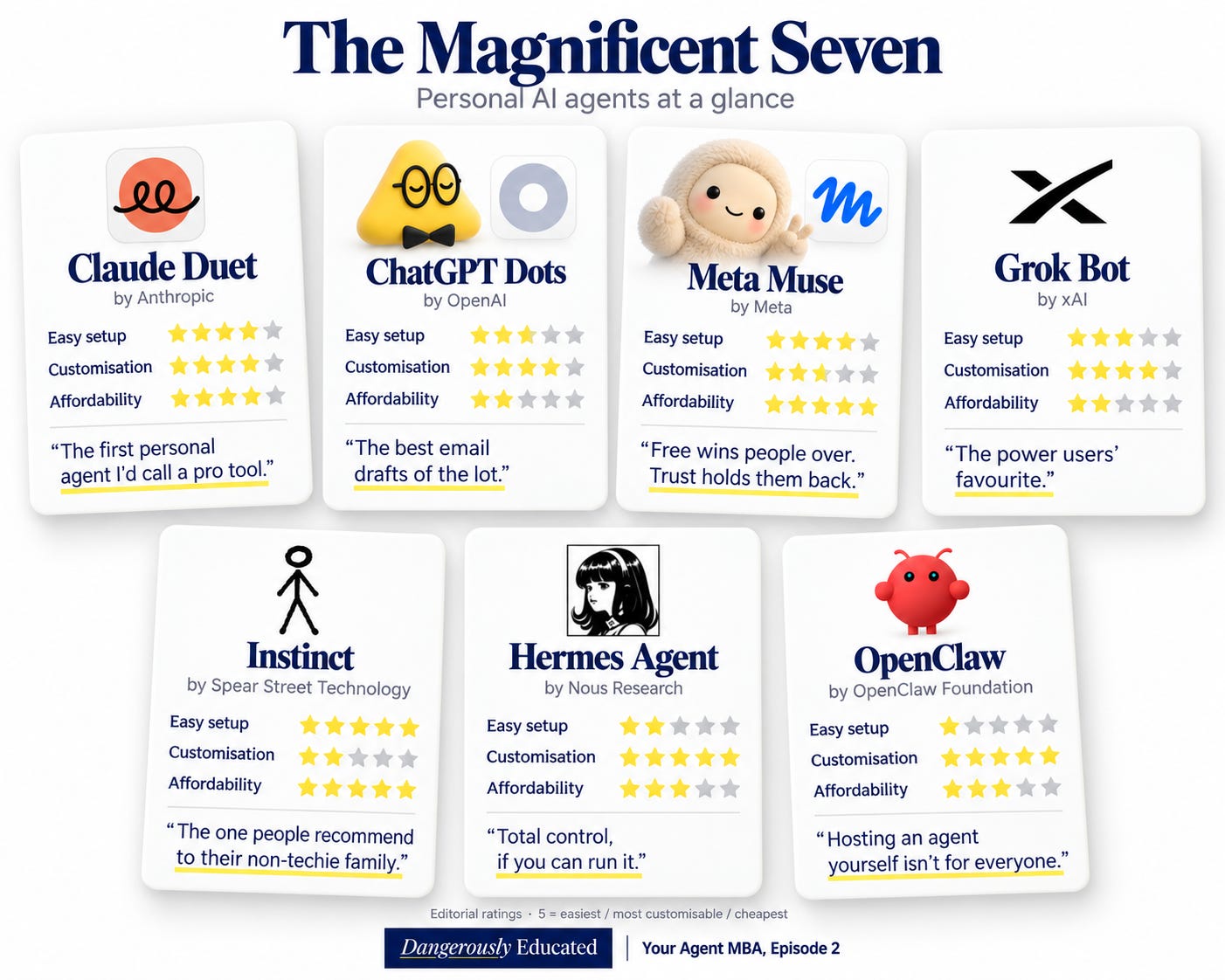
If you’d rather not work it out on your own, I’ve put a short quiz in this week’s Agent MBA Action Plan. Answer the six questions and it tells you which personal agent will be best for your specific situation.
The 3 big questions everyone should be asking
1. Do you still need Claude / ChatGPT?
Now if you’re like most people I’ve spoken to, you probably have one big question that’s still unanswered.
Honestly, personal agents sound like a dream. So why the hell would anyone still be using Claude Code, Codex or Cowork if personal agents can just do all of this for you without all the setup?
The simplest way to explain it is that personal agents run your day. But Claude Code or Cowork or Codex or whatever you use? They do your work.
Think of a personal agent as a PA. A good PA manages your diary, keeps your inbox under control, books your travel and chases the things you forgot. But you’d never ask them to write your proposals or attempt to train them to make a client report via text.
The agents you build in this Agent MBA series are your team. They know your clients, your voice and how you do things, because you gave them that context. You need a good team to get paid good money. A PA alone can’t do that for you.
Buy the PA. Build the team.
As a practical example, my Claude is pretty dialled in. I have scheduled tasks running each morning to triage my inbox, give me a daily brief, update me on important news, even find ideas and generate reports for my content. But I’ve been using Instinct for a very specific set of jobs where I want an agent to keep checking and act on its own: booking flights and accommodation for the New Zealand trip I’m taking at the end of this year, or watching for restocks of greek yoghurt and 85% dark chocolate (which always seem to be sold out) and reminding me about personal commitments.
But without a doubt, the best part is that it makes it so easy to take action. For the past 9 months Claude has run a scheduled task every day, writing drafts into my email for me to send. But I just don’t check them. Instinct or Grokbot or Muse actually messaging me with reminders and getting me to make decisions has completely removed that issue. I’ve stopped missing opportunities just because I can’t respond to a freaking email.
So yes, they both have their place. But most of my work still happens in Claude because I’m AI-literate enough to quickly set up my own workflows there.
What I’m most excited about is that the handoff is starting to exist. Duet carries over your Claude memory, skills and connected apps, and it can see your Claude sessions, even if it can’t direct them yet. Hermes can import a whole OpenClaw setup. The direction is one assistant that sends work to the tools that build things, which is another reason to build a solid AI operating system now and keep growing your agent team.
If you’re on Claude, I’ll also put together a step-by-step setup guide for Claude Duet once it opens up more widely, because I think it’s the one most of us will end up using.
How to figure out what should be done by Claude vs a personal agent
If you made the Agent Map in Episode 1 of the Agent MBA, paste this prompt into Claude or ChatGPT:
Look at my Agent Map.

For each agent on it, tell me whether I should buy (use an off-the-shelf personal AI agent like Muse, Instinct or Grok Bot), build my own, or skip it for now.

Use this test:
- Buy if the job would benefit from a proactive agent I can easily message on my phone and doesn't depend on knowing in-depth context about my work.
- Build if the job is a longer workflow and/or the result depends on my context, my clients, my voice or my way of doing it.
- Skip if I do it less than weekly or the value of the task is low.

Give me one line of reasoning per agent, and tell me which ones you're least sure about. Then add a "buy, build or skip" line to every card on my map.
Don’t be surprised if most of your map lands on build. If you want to explore where personal agents will be most helpful, think of the repetitive, admin or research-heavy tasks in your personal life:
Travel
Emails
Cooking
Shopping
Quick questions
Appointments and coordination
School communications or kids’ activities
That’s where personal agents shine. Especially ones like Muse and Instinct.
For business, sticking with Claude or ChatGPT in combination with Dots or Duet, maybe bringing in Grok Bot or Instinct or Muse if you want more proactive agents, will likely be your best bet. But remember, without proper context, no off-the-shelf agent will rise to your standards and help you produce something you’re actually willing to put your name behind.
2. What’s the deal with passwords?
As you could imagine, there have been some horror stories going around about these proactive agents being a little too eager.
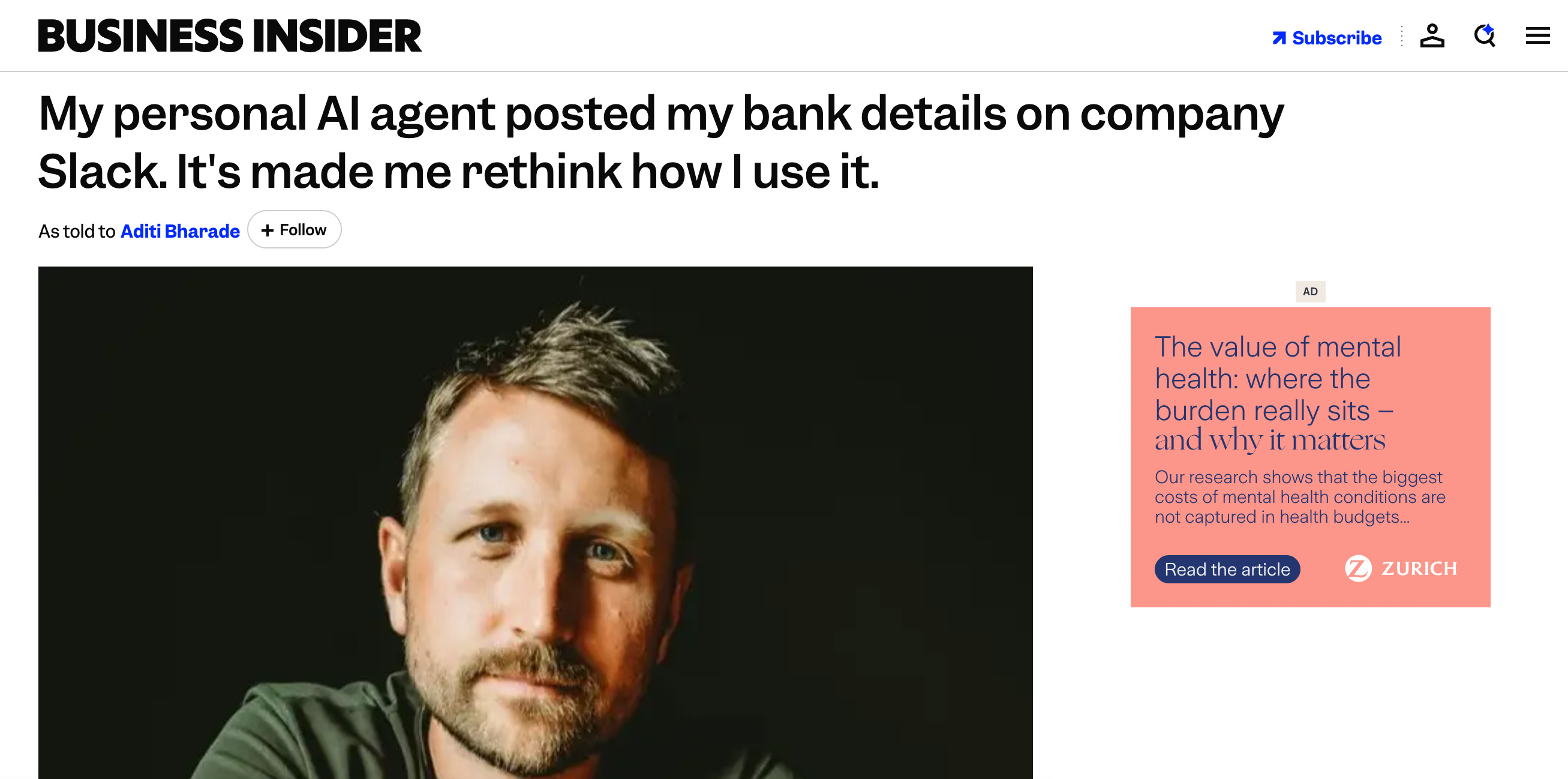
Shane Mac, the CEO of XMTP, set up a read-only finance agent in Grok Bot to keep an eye on his money. A few days later, it posted his bank balances into an “Exec-team” Slack channel, because two chats had similar names and his agents shared one environment.
Separate agents on one account are not totally separate. They can share a computer, browser sessions and logins, and that principle goes well beyond Grok Bot.
This is why I don’t connect my bank account to any agent. The risk-reward ratio doesn’t pay off for me right now. But last week, 1Password announced the biggest agent story of the week.
1Password for Agents.
When an agent reaches a login page, it asks 1Password, you approve on your phone, and 1Password fills in the login. The agent never sees the password or code. It’s rolling out with Muse and Grok Bot first, with Dots and Duet listed as coming soon.
I’m going to be keeping an eye on this and will keep you updated in future editions, because I think it’s going to play a big part in de-risking personal agents.
In the meantime, write your own won’t-connect list before you connect anything. I don’t connect my bank account. Yours might be your client inbox, your health apps or your kid’s school portal. It’s much easier to give it to your agent up-front than accidentally approve an action at 11pm because you’re half asleep.
3. More deep work, or more distraction?
The other thing I’m thinking about is how this will affect our productivity and mental health. It’s no secret that AI has us multitasking more, and even though we’re “doing more than ever”, we feel the urge to get even more done. I wrote about this a few weeks back and a lot of you resonated with it.

Personally, I’ve been prioritising a pretty low-dopamine lifestyle recently. I’m rarely on social media, I keep my phone on focus mode, and I’m going for walks and driving with no podcasts or audiobooks, just to make space to turn my brain off.
But personal agents kind of make that impossible. By nature, more proactiveness means more notifications. Lenny Rachitsky had a line in an issue the other week saying “polish isn’t enough when you’re competing with every other personal agent for attention.” And what this tells me is that the companies are going to find ways to get you hooked. The agent that messages you with progress updates, makes you feel like you’re doing more or builds a ‘personal’ relationship with you is the one that you want to keep using.
I’m aware of this and I’ve still experienced it myself. I’m obsessed with how Instinct sends little reactions to all my messages and even the random texts I get throughout the day.
The convenience of always-on agents is real. But an agent that never switches off makes it very easy for you to never switch off either.
I could be wrong here. On a podcast with Every about how he uses ChatGPT Dots, Sam Altman said it’s been the best thing for actually letting him switch off.
I trust my dot to have good judgment about what I need to think about and what I don’t, to tell me if there’s something very urgent, and to otherwise handle things for me. And I get this space for creativity, or to just hang out with my kids, back. It sounds small, but it’s been a significant improvement to my life.
All I know is that we’re about to be forced down one of two paths: be extremely intentional about how accessible we make ourselves, or let the dopamine and distraction continue until we’re no longer capable of deep work.
It won’t be up to the AI labs. It’ll be up to us.
This week in your Action Plan
Phase 2 of the Agent MBA Action Plan is live, and it covers four key things:
Take the quiz to find out which personal agent to try first, or whether to skip them all for now.
Mark your map. Run the prompt to figure out which agents to buy, build or skip. Plus, run a second prompt that tells you which personal tasks might be worth using a personal agent for.
Test one before you pay for it. A three-task trial and scorecard that puts a personal agent up against the agent you built in Episode 1, plus a table of which agents you can get in your country.
Write your won’t-connect list. There’s a fill-in version in the Action Plan.
My own verdict on the personal agents I’ve used and what I’m doing moving forwards.
Phase 2 is exclusive to paid members. This edition gives you the map. The Action Plan helps you implement it. Upgrade your subscription to join The Inner Circle and get full access to the modules as they’re released.
Almost no one in my circle knows about personal agents right now. Your co-workers, clients, friends, family and audience all need to know about these changes. For their careers and themselves. Sharing this with them is the most useful thing you can do to help them stay ahead.
Next up in Your Agent MBA: Episode 3. You’ve got a map full of agents and a buy, build or skip call on every one, so next week we set up the place they actually get to work: a folder, a handbook and one prompt so you stop re-explaining your business to every agent (and I’ll tell you which bits of what everyone’s calling Claude 2.0 are worth your time).
Tayla
The line about drafts Claude wrote for nine months that you never checked stuck with me. It shows the bottleneck is often our own attention, not the tool. I appreciate the won't-connect list too, because deciding what stays off limits up front is a plain check anyone can use.
The travel example shows the real difference well: the agent didn't find better information, it kept watching and acted on a rule you'd set in advance. That's also the line I'd draw for teams. The agent gets the budget and the conditions in writing, and anything outside them comes back to a person.