
89 conversation starters you can use to talk to *anyone*
My ultimate guide of ice-breakers, questions and topics to build deeper relationships with colleagues, managers, mentors, friends and strangers

There’s something I’ve noticed in smart people that constantly makes them lose to mediocre people.
Honestly, it’s something that I’ve observed especially in people who want to be highly successful. Let me paint you a picture.
You’re sitting across from someone at work, at a networking event, at a coffee shop, any casual situation really. And you know you should start a conversation. But you hate small talk. You think it’s boring. You feel awkward. You can’t think of anything to say.
So you sit there staring at your phone. Or you say something like ‘hey’, ‘great weather today’, ‘what’s for lunch?’ or even worse ‘what do you do for work?’. All because you want to avoid a potentially awkward situation (which ends up happening anyway as you sit there in awkward silence).
You do this because you over-evaluate everything in your head and spend all your time thinking about deep things - that’s what makes you smart. But it means you miss out on building a network, becoming more liked, and getting your name out there - which you need for any kind of success in life.
To fix this, I’ve put together 89 of the best conversation starters I’ve found across the internet and from my own life. Questions I wish I had years ago.
Essentially, it’s a mental toolkit of conversation starters you can pull from to:
Build the type of charisma that attracts opportunities to you effortlessly, even if you’re naturally introverted or small talk makes you want to bang your head against the wall
Avoid the awkward silence when the conversation dies, and replace it with that energy that makes people feel fully comfortable around you
Make a memorable first impression on your boss, team, date or the stranger in the line at the coffee shop, without feeling like you’re performing
You don’t have to be naturally charismatic or extroverted to be the type of communicator that makes people stop, pay attention and remember you.
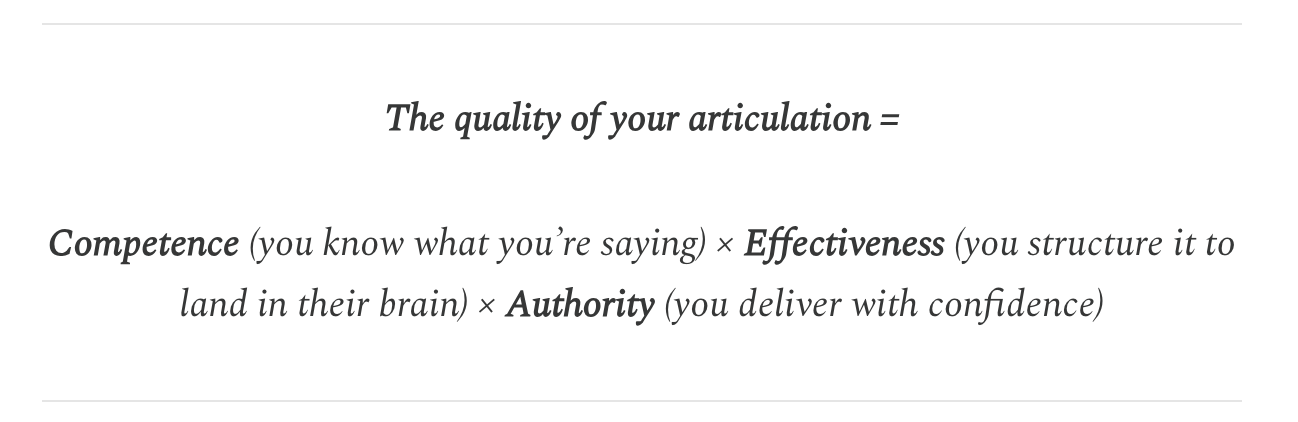
You just need to combine the articulation equation (from last week’s newsletter) with the right openers, questions, and frameworks.
This is a live resource. I’ll continue updating this list as I come across more. Feel free to save it, share it and comment with your favourite conversation starters.
This is designed to be a resource you can save and come back to before that networking event, job interview, new job, coffee catch up or on the commute to work. I’ve sorted these by situation and depth level. When you’re starting a conversation or building a new relationship, begin with the casual starters. You can gradually increase depth depending on the situation and relationship.
Mastering Communication: TLDR
General conversation guide:
First 30 seconds: Comment on a shared situation OR use the complement + question combo. Introduce yourself if needed.
Next 2 minutes: Ask 1-2 low-friction questions. Establish common ground or find an interesting ‘thread’ to continue the conversation.
Build depth: Move beyond small talk if the energy is good. Ask simple but unique questions that require people to think about their answers instead of running on autopilot. This is what makes you engaging and memorable.
Memorable exist: Finish by referencing something specific they said. Share that you’d love to catch up again and hear more about it. Follow up with a message or email later that day. Do not say you want to catch up again if you don’t mean it.
To keep the conversation going when your mind goes blank:
Steal their last word: If they say “work’s been busy”, say “busy?” and they’ll instantly expand to the level they feel comfortable with
Use the 5W’s: Encourage them to go deeper on a topic by asking a question. Start with: who, what, where, when, why (or how). This will help you overcome that mental blank.
Part 1: Starting From Zero
The Ice-Breaker
Use these when you’ve never met someone before. They work for networking events, meeting new colleagues, talking to strangers - anywhere you’re making first contact.
There are two ways to break the ice:
1. Reference the immediate shared situation
Something observable or something you have in common with the other person. A bit of humour here goes a long way.
How much trouble do you think we’ll get into if we [something related to your current situation - i.e. take a few of those croissants home for later]?
Correct me if I’m wrong, but you look like an incredibly [adjective - i.e. interesting] person to talk to.
Is this your [first / fifth / hundredth] time at this event too?
I must have missed the blue shirt memo
Simply introduce yourself: “Hi, I’m [name], it’s great to meet you.” If they don’t ask a question back, move to ‘Finding The Spark’ (below).
2. The complement + question combo
This is my favourite way to immediately create warmth while initiating conversation. (Plus, it trains you to look for the good in others.)
I love your necklace, have you always been a gold jewellery person?
You have the most amazing outfit, I have to know where you found that top!
I couldn’t help but overhear you explaining [thing you overhead], [follow up question like ‘how do you know so much about it?’ or ‘when did you discover that?’]
Finding The Spark
Once you’ve broken the ice, it’s time to ease in with a low-friction question. These conversation starters are specific enough to be interesting, but vague enough to be flexible. You can also use them in any casual conversation where you would normally turn to small talk.
Your goal here is to build rapport by finding ‘the spark’. To establish common ground, discover a topic of shared interest or land on something they’re passionate about. To learn about them while leaving them more energised than when you started the conversation.
Did you see [recent relevant event, sports game or piece of news]?
What’s been the highlight of your week?
What are you looking forward to most this [week / weekend]?
What’s the best way to help me remember your name?
Have you [read / watched / listen to] anything interesting lately?
What are you most excited about right now?
What do you do for fun?
How did you end up in [insert a relevant topic - i.e. your city / their career / at this event]?
Did you manage to get away this summer / do you have any holiday plans? Explain that you’re looking for vacation ideas. This can broaden the conversation to their favourite places to visit and why.
What about your job is most exciting right now?
So how did you get into [industry]? Explain that you love asking people this because people come through so many interesting and varied routes. This is an especially great question for mission-driven industries.
If you find that spark, the conversation should continue smoothly for a while and leave you in the perfect position to move to the next category.
Part 2: Beyond Small Talk
Make Yourself Memorable
Once you’ve established common ground, your goal is to ask simple but unique questions that require people to think about their answers instead of running on autopilot.
These help you move past surface-level discussion and actually get to know someone. Most conversations never reach this level, because it requires some vulnerability. But this is what makes you memorable, what makes someone finish talking to you and think ‘wow, that was the best conversation I’ve had in a while’.
Use your judgment - if someone seems rushed or closed off, stay surface level. If they’re engaged and present, go deeper.
What’s your biggest goal this quarter?
What’s changed the most in [their career / area] over the past year?
Are there any problems you’re trying to solve at the moment?
What’s a totally normal thing you have never done?
What do you think about the development of AI so far and where it’s going? How do you think it’ll play into our / your industry? (People will surely have an answer: some people will hate it and rant and explain why it’s a problem; others will be super excited. Respond with your own thoughts/concerns/ideas.)
What’s one thing you know a lot about that would surprise people?
If you could change one thing about [insert a relevant topic - i.e. work / your city / our generation], what would it be?
If you weren’t doing [their current career], what would you be doing? Why don’t you do that now?
What’s something everyone in your field believes that you think is wrong?
Building Deeper Relationships
You probably want deeper relationships. You want friendships that feel like you truly know each other, romantic connections that make you feel fully accepted and to get to know your parents as real people, not just ‘mum and dad’.
I want this too. For a long time, I thought the issue was the relationships themselves or that I had the wrong friends. But in reality, I was the problem. I wasn’t creating opportunities for deeper connection. I didn’t know how.
The good news is that most people want the exact same thing. So your friends, partner, family are probably feeling the same way. These questions help you build those deeper connections we’re all craving right now.
What’s something you’re working on that most people don’t know about?
What's something you're proud of right now that you haven't told many people about?
Who is your closest relationship and why?
Do you think you have a higher IQ or a higher EQ?
What do you think are your best assets as a friend?
What is a skill or attribute that you have that not a lot of people know about?
What is the best thing you have ever done for yourself?
If you could have it all, what would that look like?
What’s the best advice you’ve ever received?
Where is the place you feel most comfortable?
What’s your favourite thing about being alive?
How have you been changed by living where you live?
What’s the last thing you Google’d (or ChatGPT’d) out of sheer curiosity?
What do you need right now that you’re not getting?
If you could repeat one day from your life, what would it be?
If you could change one thing about your life right now, what would it be?
What’s something you’ve changed your mind about?
What’s something you used to believe that you don’t anymore?
Who do you think you are when you’re at your best?
What would you do if you knew you couldn’t fail?
What matters most to you in a [friendship / relationship]?
How to transition to deeper questions
If you’re feeling a bit uncomfortable (that’s normal), there are two approaches I’ve found helpful to move from surface level to depth:
1. Use a transition sentence:
Can I ask you something I’ve been thinking about?
You mentioned [last week / last month / earlier] that [something you discussed], and I’ve been curious…
2. Explain straight up:
“This year I’m working on forming deeper relationships with people I care about. I had a question that’s a bit more personal, do you mind if I ask you about it?”
One of my friends actually did this recently and suggested bringing conversation cards on our walks (we catch up each Monday). Everyone loved the idea. It just took one person having the courage to suggest it for our entire friendship dynamic to change.
Whatever approach you use, it’s worth having a think about your own answers to these questions. You’ll likely be asked for your own response.
Part 3: When You Need A Lifeline
How to keep the conversation going
We’ve all experienced the uncomfortable tension that creeps up when a conversation dies. The awkward silence. The slip back to small talk. You both know it’s happening, but neither of you knows how to fix it.
Don’t panic. One good question can revive everything. Here are the best I’ve found:
Conversation Extenders:
Steal their last word. If they say “work’s been stressful”, say “stressful?” and they’ll instantly expand to the level they feel comfortable with.
“Tell me more about [what they just said, or something they mentioned previously].”
Use the 5W’s: Encourage them to go deeper by asking a question. Start with: who, what, where, when, why (or how). This will help you overcome that mental blank.
Topic pivots:
That reminds me... [connect to a related but new topic]
Speaking of [loose connection], have you [new topic]?
Random question, but... [signals a deliberate shift]
How to exit gracefully
Sometimes, the conversation really is dead and the best thing for both of you is to move on. But how do you do it without coming across as rude or awkward? These phrases will help you exit gracefully:
Well [name], it was great chatting to you. [Something specific to your conversation, like ‘good luck with the project’ or ‘thanks for the advice about negotiating’ or ‘hope the trip goes well’].
It’s been great chatting, thanks so much for your time. [Exit cue, like ‘I’m going to grab another drink’ or ‘I’m going to go to the bathroom’ or ‘there’s someone I need to catch up with’, but I hope you enjoy the rest of your [day / night].
I’ve got to get back to [relevant task or activity], but it was great catching up.
I don’t mean to rush off, but I’ve got another call coming in. Let’s pick this up [tomorrow / next week].
If you want to keep chatting but wish to be respectful of their time:
“Well, I don’t want to take up too much of your time…”. See how they respond as to whether you close or continue the conversation.
For difficult conversations:
“You’ve given me a lot to think about. I’ll take some time to process this, but would love to continue the conversation [tomorrow / next week].”
Section 4: A few things I’ve learned
Always follow up
We all know the person who says “let’s catch up soon”, only to never hear from them again (or worse, have them pop up only when they need something). The follow up stage is where the real connections form. It builds trust, shows you’re reliable and creates an opening for future opportunities.
Here are a few go-to messages:
You mentioned you were working on [their thing]. I came across [relevant article/person/resource] and thought you might find it useful. Send through the resource or offer to make an introduction.
I really enjoyed our conversation about [specific thing you discussed]. I've been thinking about [related thought]. What do you think?
It was really great to meet you / chat to you [yesterday / last week]. [Mention something valuable you took away from the conversation, or an action or change you’ve made as a result]. I’d love to stay in touch and catch up again when you have some time.
Give threads to pull
Whenever someone asks you a question, don’t just answer. Create conversation.
Instead of “I’m a consultant”, say “I’m a consultant, specifically working on how businesses can use AI without losing their human touch. It’s equal parts fascinating and terrifying. What about you?”
Instead of “I’m good thanks”, say “I’m excited, I just found out [share a piece of news]” or “It’s been a rough week, I [share something honest without problem dumping]”.
The best conversations often start when you go first. When you’re brave and vulnerable, when you share something about yourself that goes beyond surface level, it gives the other person permission to do so too.
Learn how to be curious again
Speak less. Ask more questions. Dive deeper. Enter every interaction with the goal to understand something new.
Being curious makes every conversation interesting for you. It means you’ll always have something to gain. But more important is the impact it has on others.
There is no greater feeling in this world than talking with someone who seems genuinely interested in what you have to say. Be that person for someone else. (If you speak for just 20% of a conversation, you will make someone else’s day).
I’ll keep updating this as I find more conversation starters that work. If you have any that you swear by, drop them in the comments. And if you know a friend who hates small talk and networking, share this with them so they can save it for their next conversation.